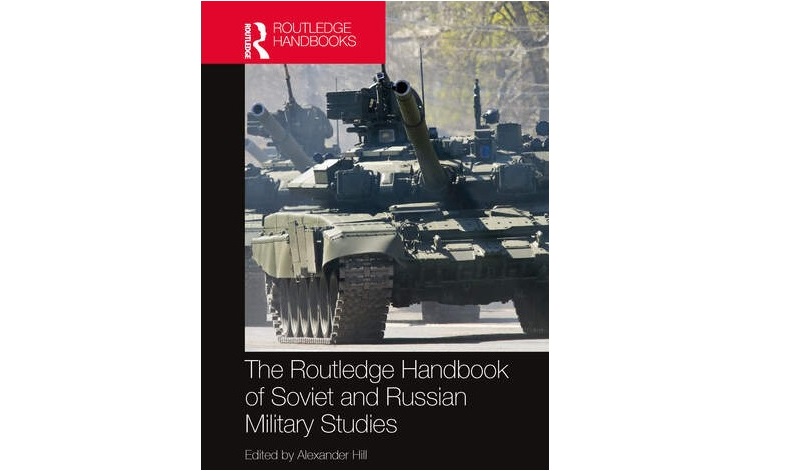
The Routledge Handbook of Soviet and Russian Military Studies
- Author
- Published on
Summary
Alexander Hill (Ed.), The Routledge Handbook of Soviet and Russian Military Studies, London, Routledge, 2025. 584 pp.; ISBN: 9781003354635.
Few subjects have become as politicised since February 2022 as the Russia’s armed forces. In Western newspapers they have been portrayed as an unstoppable steamroller and as a hollow force of conscripts and obsolete tanks. Alexander Hill, Professor of Military History at the University of Calgary, is well placed to cut through this noise.
The Routledge Handbook of Soviet and Russian Military Studies is Hill’s attempt to step back from the contemporary political fray and to examine Russian military power in its historical context. The central riddle of this edited volume is set out with unusual candour in introduction. In the current climate, “it is difficult to find contemporary analyses of the Soviet and Russian militaries that are not heavily politicized” (p. 1). In the West, Russian military strength is debated when NATO budgets are under discussion and talked down when more aid for Ukraine is being sought. Ukrainian sources have every reason to present their own forces in the best possible light. The war is taking place “in a goldfish bowl, even if the glass of the bowl is somewhat opaque” (p. 4). His answer to politicisation is history. Because both Soviet and contemporary Russian governments have treated past wars as sources of practical lessons, Russia’s present conduct can only be understood against two centuries of military experience.
The handbook is organised in three parts and a conclusion. The contributors include many of the leading Anglophone specialists in the field together with a single Russia-based scholar, Sergei Kudriashov. The Tsarist chapters establish the themes that recur throughout the volume. Alexander Mikaberidze shows that victory over Napoleon “marked a peak in Russian military power, bolstering Russian imperial glory and leaving an enduring imprint on the national psyche” (p. 30). Alexander Morrison’s chapter shows how a struggle against heat, thirst and distance shaped Russian conquest, and it draws instructive contrasts with British India. For instance, he notes that, unlike the British, the Russians rarely recruited soldiers from the conquered populations. The common lesson of these chapters is that Russia developed early a tradition of major reform in response to military setbacks, driven by a constant struggle to keep a large conscript army and a navy competitive against technologically more advanced Western rivals.
The Soviet inter-war chapters explain the origins of the distinctive Soviet approach to war. Stephen Brown and David Sutton show how the emergencies of the Civil War produced three principles that would underpin Soviet doctrine for decades: “Party control over military affairs”, the unity of front and rear in a “total war”, and “a commitment to seizing the initiative and launching decisive attacks” (p. 88). David Stone’s account of inter-war theory explains why Soviet thinkers embraced manoeuvre. The result was the theory of Deep Battle and Deep Operations, which the purges disrupted but did not destroy.
The chapters on the Great Patriotic War are very interesting. Evan Mawdsley provides a concise survey of Soviet strategy. Sergei Kudriashov’s chapter on command and control describes the dominance of Stalin, without whom “not a single important question was decided”, while insisting that “the war certainly wasn’t his personal war” (p. 145). David Stahel’s chapter on the Red Army seen through German eyes before 1941 is one of the most topical in the book: German leaders leaned on “cultural preconceptions and diehard stereotypes to address otherwise troubling gaps in German intelligence” (p. 162), a failing that he rightly suggests has echoes in some Western assessments of Russian forces since 2022.
The Cold War chapters are more technical. Hill’s chapter on Soviet military assistance and advising after 1953 is a wide-ranging survey of Moscow’s arms transfers and advisers from Egypt and Syria to Vietnam, Angola and Cuba. It ends with an important observation that many of the states that refused to condemn the invasion of Ukraine in 2022 have current military ties to Moscow or memories of Soviet support for their liberation struggles, and Russia today offers military support “with relatively few strings attached” (p. 255).
The post-Soviet chapters bring the story up to the eve of the full-scale invasion against Ukraine. Hill’s chapter on military reform between 1992 and 2021 is a balanced assessment of the reforms launched by Anatolii Serdiukov after the Georgian war of 2008. Tracey German’s chapter on the Chechen wars offers a sobering account of an army that was “configured, and had trained, for high-intensity war against NATO, not low-intensity counterinsurgency” (p. 313), and of the indiscriminate firepower and so-called cleansing operations that followed. Paul Robinson’s chapter on the Donbass war of 2014-2015 is also provocative. He classifies the conflict among what scholars call “internationalised civil wars” (p. 333), and argues that the uprising was local in origin and the rebels were overwhelmingly Ukrainian citizens. He emphasises that “far from being a hybrid war, the conflict in Donbass was decidedly conventional in nature” (p. 333).
Part II’s thematic essays are very useful for teachers and students. Chris Bellamy’s essay on hybrid, non-linear and new-type warfare is an invaluable guide to Russian terminology, showing that what Western commentators presented after 2014 as a new Gerasimov doctrine had deep roots in Soviet thinking. Hugh Davie’s chapter on logistics from 1700 to the present is a rare treatment of a neglected subject. He argues that Russian logistics “reached their zenith during the Soviet-German War” (p. 365) and that “the Russian concept of logistics is formulated to deliver mobility and combat power, with sustainability as a secondary consideration” (p. 366), which helps explain the stalled columns north of Kyiv in 2022. The most damning verdict comes from Alexander Statiev, who shows that class-based counter-insurgency failed in Afghanistan because “traditionalism and tribal loyalties superseded class affiliation” (p. 447). He warns, “the absence of an articulated doctrine with sound political components promises Russia grave problems in future counter-insurgency campaigns” (p. 447).
Part III, on the war in Ukraine, would attract attention as well as controversy. Hill’s chapter on the military successes and failures of 2022 begins by setting out four aims of the Special Military Operation identifiable in Russian government sources: securing the Donetsk and Luhansk People’s Republics, protecting Crimea, halting NATO expansion, and the vague goal to “demilitarise and denazify” Ukraine (p. 471). He explains why an invasion force of roughly 190,000 overran large areas through surprise but could not hold them, before the Russian government and armed forces “upped their game” late in the year. He gives due weight to the improvement of the Ukrainian army since 2014. The mobilisation of autumn 2022, in Hill’s reading, turned the operation into “a full-scale war in all but name” (p. 482).
Paul Robinson’s chapter with Hill covers January 2023 to July 2024: the failed Ukrainian counter-offensive of 2023 and the ubiquity of first-person-view drones, produced “an increasing spiral of combat in the electromagnetic spectrum” (p. 503). The authors argue that defence held the advantage on this transparent battlefield and that “the Russian response to the advantage enjoyed by the defence was to embrace attrition” (p. 503). Andrei Tsygankov’s chapter maps the Russian debate between Balancers, for whom “Russia has crossed the Rubicon” (p. 527) and the war marks Western decline, and their Institutionalist critics, who regard the war as unwinnable. He concludes that by refusing earlier negotiations the West strengthened the hand of the hardliners.
The volume closes with Hill’s own essay on a Russian way of war. Its most original argument concerns culture. Hill suggests that the reckless initial thrust towards Kyiv in 2022 fits a recurrent pattern in which commanders first try to rush an objective and only then settle into a methodical approach, a tendency Dmitry Adamsky has compared to Israeli “learning by friction” (p. 542). Other continuities include the stockpiling of old equipment, so that the war “is still largely being fought with 20th-century weapons” (p. 543) and the habit of adopting new technology and producing it in overwhelming quantities.
Overall, the handbook is the most comprehensive single-volume scholarly work of the subject in English. Its great strength is the depth of time it brings to a war too often discussed as if it had no history. Readers who are interested in Ukraine will also develop greater understanding on why Suvorov, the Great Patriotic War, Deep Operations and the Chechen wars still matter in Moscow. Hill is also candid about the state of the field. Editing the volume brought home “the fact that there are relatively few genuine specialists on Russian military matters in the English-speaking world” (p. 539), a scarcity he attributes to complacency after 1991 and the retreat of political science from area studies, which has led to “the rise of the ‘military expert’” (p. 540) without the language or cultural knowledge to interpret what he sees.
The editor has achieved a rare coherence across thirty-six chapters, and the volume will be an indispensable reference for anyone seeking to understand how Russia fights and why. At a time when debate about Russia is dominated by wishful thinking on one side and propaganda on the other, a handbook that asks readers to take Russian military history seriously on its own terms performs a real public service. The Routledge Handbook of Soviet and Russian Military Studies therefore deserves a wide readership.
Disclaimer: Views expressed are of the author(s) and do not necessarily reflect the views of The Statecraft Institute.